
Families across Georgia often search for support when a child requires ongoing medical assistance at home. The Georgia Pediatric Program, commonly referred to as GAPP, provides skilled nursing and personal care services to medically fragile children whose needs exceed what a family can manage alone.
Understanding which circumstances are typically covered can give parents the confidence to take the necessary steps. To qualify, a child does not need to be in a hospital or a facility. In fact, the goal of GAPP is to keep children out of the hospital. Many families apply because their child requires complex medical treatments, equipment management, or daily assistance to livafely at home.
How GAPP Determines Eligibility
Eligibility for GAPP is primarily determined by medical necessity. While GAPP is a Medicaid program, families who do not meet standard financial criteria can often still qualify through the Katie Beckett Deeming Waiver. This waiver looks at the child’s institutional level of care rather than the parents’ income, ensuring that medically fragile children can access services regardless of family finances.
To be eligible, children must require skilled nursing attention or personal care based on documented health issues. Physicians, specialists, and home health nurses play a significant role in evaluating a child’s specific needs, ranging from developmental limitations to continuous medical care like suctioning, tube feeding, or seizure monitoring.
The program’s aim is to keep medically fragile children comfortable, safe, and in their homes.
Conditions Most Commonly Covered by GAPP
Although any critical health problem that requires competent professional care can be considered valid, certain diagnoses are frequently approved. These conditions usually result in long-term needs that are best managed with the help of nurses at home.
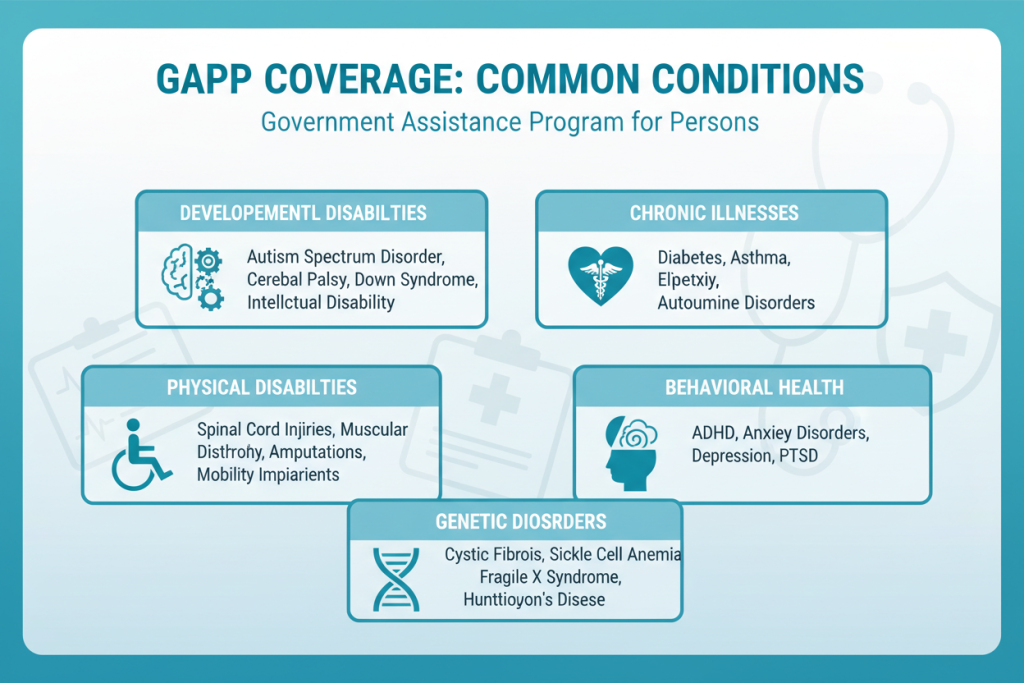
Below are the most frequent health issues observed in children receiving GAPP services across Georgia.
Cerebral Palsy (CP)
Cerebral Palsy is one of the primary conditions that qualify children for GAPP. Children with CP may struggle with motor control, feeding, breathing, or muscle rigidity that necessitates consistent therapy and intervention. In cases where the condition restricts essential activities—such as eating, bathing, moving, or maintaining airway safety—skilled home nursing is often required.
Many children with CP depend on gastrostomy tubes (G-tubes), wheelchairs, orthotics, or respiratory equipment. GAPP services support families by managing this equipment to prevent complications. Parents often report that having skilled nursing help significantly reduces stress and ensures their child receives safe care throughout the day.
Spina Bifida
Spina Bifida is another complex condition often covered by GAPP. Depending on the severity of the defect, children may face challenges with mobility, bladder and bowel control, skin integrity, or neurological function.
Patients requiring catheterization, specialized positioning to prevent pressure sores, and infection monitoring are typically eligible for in-home nursing support. Reduced sensation below the lesion level makes skin breakdown a high risk; a trained nurse can monitor this to promote long-term health.
Medically Fragile Children
The program is comprehensive regarding children defined as “medically fragile”—those experiencing complex or persistent health issues. These conditions vary widely but often include respiratory complications, heart defects, immune system deficiencies, or severe feeding disorders.
Examples include:
- Children dependent on supplemental oxygen.
- Infants with chronic lung disease (CLD).
- Children requiring frequent suctioning to clear airways.
- Babies with “failure to thrive” or significant feeding challenges.
- Children utilizing feeding tubes or specialized nutrition support.
A child with a fragile medical history requires the close supervision that only a professional can provide. GAPP works with families to ensure these children remain safe while growing and developing in their own homes.
Genetic Disorders & Neurological Conditions
Certain genetic conditions restrict motor capability, muscle strength, or cognitive growth to the point where structured professional care is necessary. These include conditions like Muscular Dystrophy, chromosome disorders, Rett Syndrome, or metabolic conditions that influence growth and energy levels.
Additionally, severe seizure disorders often qualify for GAPP eligibility. Skilled nursing is vital for children with high-frequency seizures who cannot control body functions or require specialized safety equipment. Seizure monitoring and the administration of rescue medications are critical responsibilities that are safely performed by trained nurses.
Developmental Delays and Complex Medical Needs
Children with significant developmental delays often need assistance with feeding, swallowing, mobility, and self-care. A child may be evaluated for GAPP if these needs present a safety risk without professional assistance.
Complex medical needs often include:
- Tracheostomy care.
- Ventilator support.
- Central line care.
- Frequent respiratory treatments.
- Behavioral or cognitive conditions combined with medical limitations.
These situations place heavy demands on families. In-home nursing care provides stability for the child and minimizes caregiver burnout for the parents.
Identifying Signs That a Child May Need GAPP
Parents often ask, “When should I seek in-home nursing?” Certain signs are evident in daily activities, while others appear during medical visits. Recognizing these signs can help families take early action.
Signs that a child may benefit from GAPP include:
- Safety Concerns: Difficulty completing daily tasks safely without total caregiver assistance.
- Frequent Interventions: Need for medical treatments multiple times throughout the day.
- Feeding Issues: Reliance on a feeding tube or severe challenges with swallowing/aspiration.
- Mobility Limitations: Inability to move without special equipment or positioning assistance.
- Health History: A history of frequent hospitalizations or recurring illnesses.
- Caregiver Exhaustion: Increased parental stress due to the intensity of medical care requirements.
- Critical Management: Needs related to seizures, respiratory distress, or airway management.
If your child routinely needs close observation or specialized care, applying for GAPP may significantly improve your daily life.
Why GAPP Matters for Families in Georgia
Parents caring for medically fragile children balance standard parenting tasks with medical responsibilities that require precision and skill. GAPP provides families with trained personnel who are conversant with medical procedures, emergency protocols, and equipment management.
This program does not only protect the health of the child; it allows parents and siblings to find a better life balance. Most families report improved emotional well-being, increased home safety, and general confidence once services are initiated.
How to Apply for GAPP
In Georgia, families generally start the process with the assistance of a pediatrician, specialist, or a licensed home care provider. A comprehensive medical history is essential.
After collecting the necessary information, a nurse evaluator examines the child to define the extent of care required (known as “hours of care”). To ensure a smooth process, having your documentation organized is key.
| Requirement | Why It Matters |
| Child’s Medical History | Verifies diagnosis, treatment details, and daily medical needs. |
| Physician Documentation | Confirms the medical necessity for skilled nursing or personal care services. |
| Therapy Evaluations | Reports from PT, OT, or Speech Therapy show mobility limits and developmental abilities. |
| Current Medication List | Helps reviewers understand ongoing treatments and meds requiring monitoring. |
| Medical Equipment List | Identifies devices (feeding tubes, oxygen, vents) that require skilled maintenance. |
Supporting Children with Long-Term Care Needs
Children with conditions such as cerebral palsy, spina bifida, seizure disorders, and chronic respiratory delays often need care that goes beyond typical parenting. GAPP is a well-organized, professional resource that ensures the safety of children and allows them to address their daily medical needs in the environment where they feel most at home.
Do you think your child might qualify?
Don’t navigate the medical system alone. Contact us today to discuss your child’s needs and let us help you understand the GAPP application process.