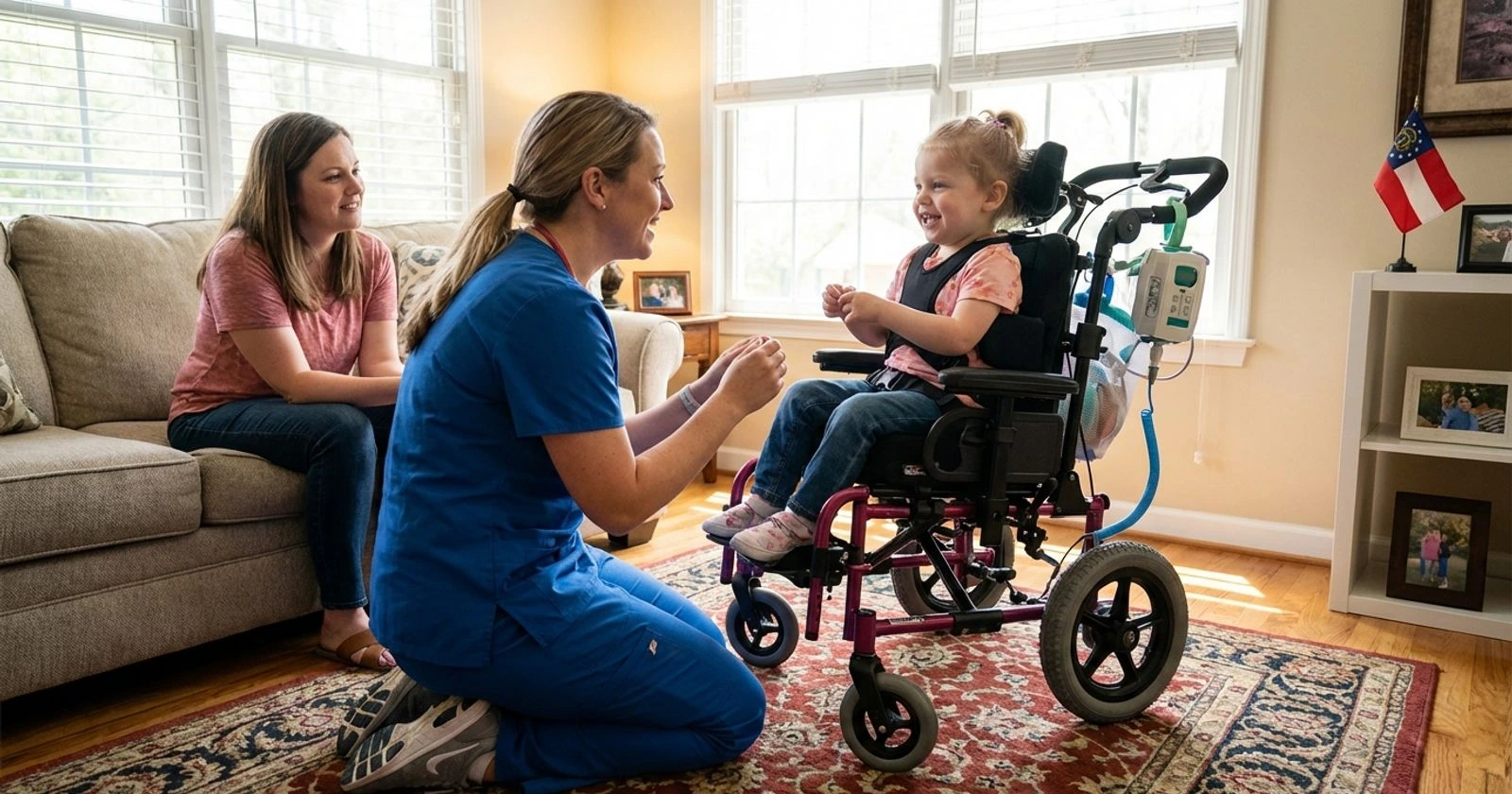
Discover how to secure free in home care for a disabled child in Georgia through the 2026 GAPP Medicaid program. Skip the waitlists and get the skilled nursing your medically fragile child needs.
Securing state funded nursing for a medically complex child does not require languishing on a multiyear waiver waitlist. The reality is that
free in home care disabled child georgia programs operate as a strict entitlement under Medicaid. GAPP is not a waiver program with a multiyear waitlist; eligibility is decided on medical necessity and Medicaid status.Parents often rely on outdated advice about waiver caps, but the 2026 Georgia Pediatric Program application actually functions as a precise medical audit. SLB In-Home Care provides skilled and unskilled nursing, at no out of pocket cost once approved by Georgia Medicaid, for medically fragile children through the GAPP Medicaid program.
Quick Summary- The Georgia Pediatric Program (GAPP) provides services for medically fragile children ages 0-21.
- Applications in 2026 require electronic submission via the Gainwell portal, including the DMA-6A and Appendix Y PPOT forms.
- Common prior authorization denials can be avoided by working directly with regional GAPP representatives rather than general hotlines.
- Foster children in Georgia have specific GAPP integration pathways through DFCS Health Connect America to stabilize placements.
Table of Contents
Understanding Eligibility for Free In Home Care Disabled Child Georgia Programs in 2026
The rules governing pediatric nursing in Georgia follow strict clinical guidelines. The 2026 age parameters for GAPP eligibility specifically target children ages 0-21 who require ongoing medical support.

Once a patient turns 21, they immediately age out of GAPP and must transition to adult Medicaid waivers like CCSP or SOURCE. Parents mapping out their child’s care plan must account for this exact cutoff date to prevent sudden lapses in nursing coverage.Georgia’s Katie Beckett pathway, also called the TEFRA or Deeming Waiver, is still active and can help a child qualify for Medicaid based on the child’s own needs rather than parent income. See the
official Georgia Medicaid TEFRA/Katie Beckett page and our
Katie Beckett waiver guide for Georgia. GAPP eligibility itself relies on Medicaid status and strict medical necessity.For GAPP, the state does not look at waiver slots, but rather looks exclusively at the clinical documentation proving your
child requires skilled intervention to remain safely at home to understand how these entitlement structures shifted over the years.The state categorizes support into two distinct operational tiers. Skilled Nursing Care involves complex medical interventions performed by an RN or LPN. This includes post surgery care,
ventilator management, tracheostomy suctioning, and continuous seizure monitoring. Unskilled Personal Care covers essential daily living activities managed by certified aides.These tasks include bathing, feeding assistance, mobility transfers, and hygiene maintenance. Both levels of care are fully covered under GAPP when properly documented.
Step by Step 2026 GAPP Application via the Gainwell Portal
The 2026 system demands a mandatory electronic submission process through the Gainwell portal. Your primary physician must properly file the DMA-6A form to initiate the request. This document must be accompanied by the Appendix Y PPOT, which serves as the formal Pediatric Plan of Care.Having audited numerous clinical submissions, I consistently notice that missing a single physician signature on the Appendix Y triggers an automatic rejection before a human ever reviews the file.Once submitted, the file moves to the Alliant Health review process for a rigorous clinical audit. You must enter up to 10 accurate diagnosis codes (ICD-10) to definitively prove medical necessity. Listing a primary diagnosis alone rarely secures approval.Reviewers look for secondary and tertiary codes that explain the compounding complexity of the child’s condition. For example, if a child has cerebral palsy, the application must also code for the associated dysphagia, respiratory distress, or muscle spasticity that specifically dictates the need for daily nursing care.Parents should never let an agency guess diagnosis codes. Request a printed summary from your child’s most recent hospital discharge or specialist visit and match the ICD-10 codes exactly on the DMA-6A. Caregiver competency requirements represent another major administrative hurdle outlined in Appendix J.The state requires confirmation that primary caregivers are trained on the child’s baseline needs before authorizing home nursing. This documentation must be completed and signed during the initial planning meetings.Post approval, the Department of Community Health (DCH) and Alliant enforce strict quality assurance protocols. They conduct unannounced audits to verify the approved nursing hours are actively staffed and that clinical notes align with the original Appendix Y plan. Official
GAPP presentation guidelines detail these exact compliance standards for maintaining active status.
Medically complex foster children require rapid intervention to prevent hospital readmissions. Georgia manages this through a specific integration of GAPP services with DFCS Health Connect America. This initiative served 104 high needs children in recent years and continues to expand its footprint in 2026.

The goal is to provide immediate nursing support to foster families who take in children with tracheostomies, feeding tubes, or severe neurological conditions.My analysis of recent CFSR 4 Data Profiles reveals a direct correlation between nursing support and placement stability. The projections regarding permanency needs in Georgia show that in home nursing stabilizes placements for medically fragile youth.Managing a medically fragile child’s daily care without state support is like running a standalone intensive care unit without a staff rotation. Foster parents are significantly less likely to request child removal when they have an RN or LPN managing the overnight medical shifts.To accelerate approvals, agencies must bypass the general state hotlines and connect directly with regional GAPP representatives. Establishing a direct line with these specific coordinators prevents the DMA-6A from stalling in the general queue.
| Region | GAPP Contact | Primary Focus Area | Best Use Case |
|---|
| SE Metro | Ebony Hill | Complex PA Escalations | Resolving stalled initial applications |
| Augusta | Jessica Bowen | Clinical Documentation | Verifying Appendix Y accuracy |
| NW Georgia | Tierra Johnson | Foster Care Overlaps | Expediting DFCS placements |
Working directly with regional contacts accelerates the approval process for both biological families and foster parents. Standard industry practice often involves submitting paperwork into the portal and waiting for a response. Local providers focus on actively coordinating with these regional representatives to clear administrative bottlenecks and verify clinical details.
How to Avoid Common Prior Authorization Denials
Prior authorization denials disrupt care and force families into stressful appeals. Parents need to understand the most frequent denial codes in the 2026 system to protect their nursing hours. Code 535 indicates timely filing errors.This happens when an agency submits the reauthorization packet after the current approval has already expired. Code 3000 is a general administrative rejection, usually triggered by missing physician signatures or incomplete demographic data on the DMA-6A.Code 3011 is strictly a scheduling error. It means the Date of Service does not fall within the approved Prior Authorization dates. Agencies prevent Code 3011 by meticulously aligning nursing schedules with the exact authorization windows dictated by Alliant Health.If an approval starts on a Tuesday, billing for a shift on the previous Monday triggers an automatic system denial and flags the account for an audit.In my professional practice coordinating pediatric care plans, using dedicated GAPP Application Assistance proves to be the most effective way to eliminate these paperwork errors before submission. SLB In-Home Care provides dedicated consulting to ensure every diagnosis code, signature, and date aligns perfectly with state mandates.org/am-i-qualified/) to secure expert support at zero out of pocket cost before the next authorization window closes.
Planning for Long Term Pediatric Nursing Success
The Georgia Pediatric Program strictly serves medically fragile children ages 0-21. Once a patient reaches their 21st birthday, families must have a transition plan in place for adult Medicaid services.Applications in 2026 require precise electronic submission via the Gainwell portal, rendering paper forms obsolete. Success depends entirely on the accuracy of the DMA-6A and the clinical detail provided in the Appendix Y PPOT.Common prior authorization denials, specifically codes 535 and 3011, are entirely preventable. They stem from administrative oversights rather than medical ineligibility. Working directly with regional GAPP representatives ensures these errors are caught and corrected quickly. Foster children in Georgia have specific GAPP integration pathways through DFCS Health Connect America.This partnership remains vital for maintaining placement stability and ensuring foster parents have the medical backing they need to care for high needs youth.Securing reliable
free in home care disabled child georgia resources ultimately comes down to meticulous documentation and proactive scheduling. By understanding the exact clinical criteria and avoiding common submission pitfalls, families can maintain continuous nursing support without unnecessary interruptions.
Frequently Asked Questions
What is the exact age limit for GAPP services in Georgia?
The program covers eligible patients ages 0-21. Coverage terminates immediately when the patient turns 21.
Why was my GAPP prior authorization denied?
Denials are usually administrative. Code 535 means your agency failed to meet timely filing deadlines for reauthorization. Code 3011 means the nursing dates of service fell outside your approved authorization window.
Does GAPP cover medically fragile foster children?
Yes. Foster children access these services through specific DFCS and Health Connect America pathways designed to expedite care. This integration helps stabilize placements for youth with complex medical needs.
How do I get free in home care disabled child georgia services started?
You must submit a DMA-6A form and an Appendix Y PPOT through the Gainwell portal. The state will review your up to 10 diagnosis codes to confirm medical necessity before approving hours.
Related Guides