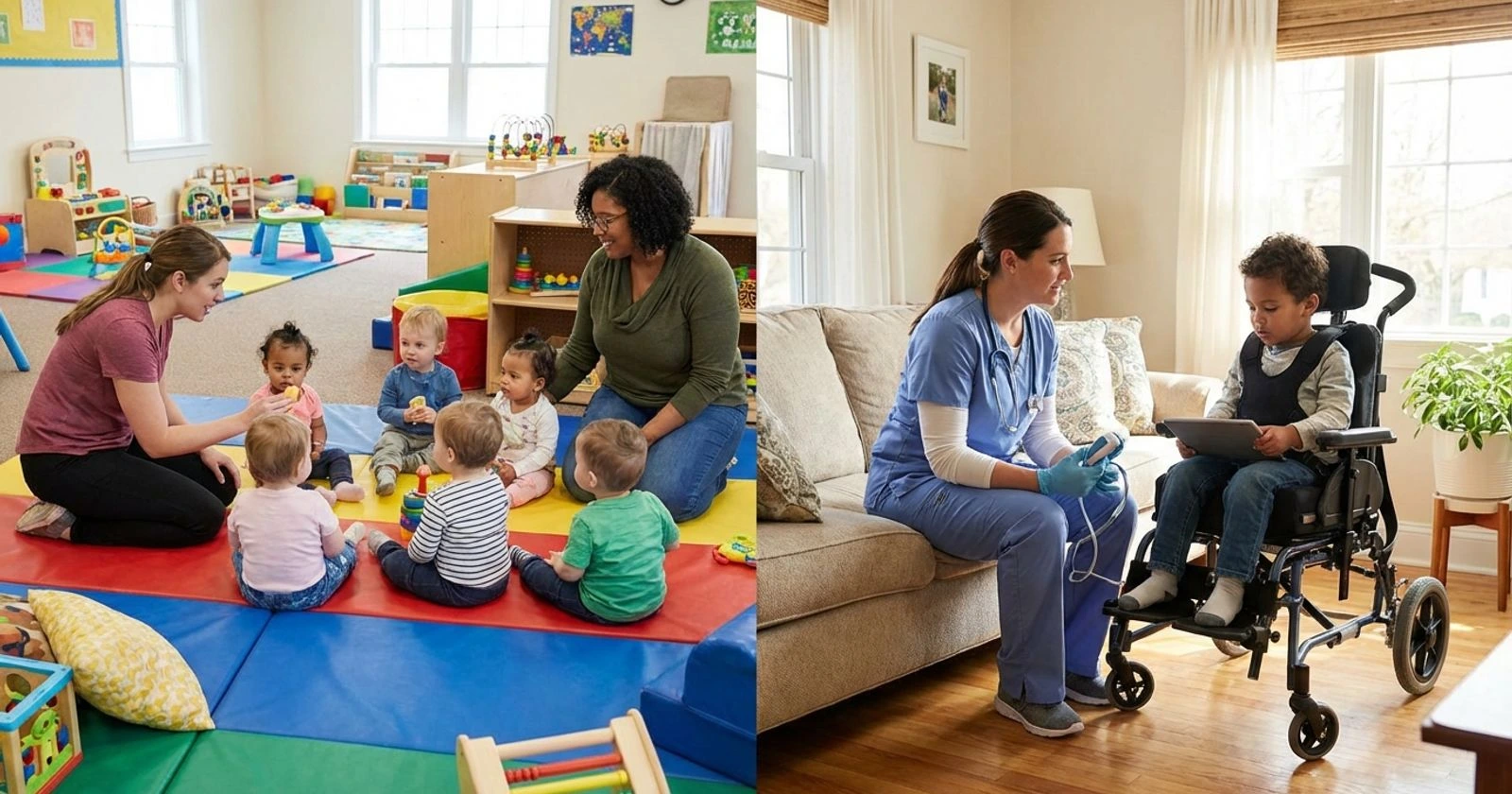
Compare pediatric daycare vs in home nursing for medically fragile children. Learn how Georgia GAPP covers 100% of in home care costs to keep your child safe.
Are you paying high pediatric daycare copays while secretly worrying your immunocompromised child will catch another respiratory virus? Choosing between socialization and medical safety is a false compromise that leaves Georgia families physically and financially exhausted. The reality is that for medically fragile children, facility based care often introduces unnecessary risks that a controlled home environment completely avoids.
Quick Summary- Pediatric daycare exposes medically fragile children to high viral transmission risks, leading to preventable hospital readmissions.
- The Georgia Pediatric Program (GAPP) pays for approved in home nursing hours, so Medicaid eligible families have no out of pocket cost for those hours when approved by Georgia Medicaid.
org/blog/free-in-home-care-disabled-child-georgia-gapp) provides superior isolation for post surgery recovery, especially for ventilator dependent children.
- Securing GAPP approval in 2026 requires strict adherence to electronic DMA-6A submissions and Appendix Y PPOT guidelines.
Table of Contents
The Hidden Risks of Pediatric Daycare for Medically Fragile Children
Stop risking your child’s health for the illusion of socialization. Parents are frequently told that children need facility based environments to develop social skills. For immunocompromised children, crowded facilities are simply breeding grounds for RSV, influenza, and common adenoviruses.

A child relying on a feeding tube or ventilator gains absolutely no developmental advantage from being exposed to community transmission. The controlled isolation of in home care prevents these severe medical setbacks and keeps your child out of the emergency room.The debate of pediatric daycare vs in home nursing ends when you examine the hospitalization data. Shared facilities inevitably lead to higher readmission rates for fragile kids. When one child in a daycare center gets sick, the entire classroom is compromised within days.In home nursing eliminates this variable entirely by creating a clinical bubble around your child. Nurses follow strict infection control protocols that are impossible to maintain in a room full of active toddlers.Post surgery recovery highlights this difference perfectly. A child recovering from a tracheostomy placement requires a sterile, tightly managed environment. Daycares simply cannot provide the clinical isolation required for these complex medical states.Their staff members are spread too thin across multiple children to monitor subtle changes in oxygen saturation or airway clearance. In home care ensures a dedicated medical professional is watching your child’s specific vitals without distraction.SLB In-Home Care provides skilled and unskilled nursing, at no out of pocket cost once approved by Georgia Medicaid, for medically fragile children through the GAPP Medicaid program. This service model eliminates the need to gamble with facility based care by bringing the clinical environment directly into your living room. Families receive professional medical support without exposing their vulnerable children to the daily viral roulette of a public daycare center.
Quick Comparison: Pediatric Daycare vs In Home Nursing at a Glance
Let us look at the raw financial and medical data. Pediatric daycares drain family budgets through monthly tuitions, steep enrollment fees, and daily copays. The Georgia Pediatric Program completely shifts this financial burden for qualifying families.GAPP targets medically fragile children ages 0-21 based strictly on medical necessity. If your child qualifies, the state covers the cost of care entirely.
| Feature | Pediatric Daycare | GAPP In Home Nursing |
|---|
| Out of Pocket Costs | High copays and monthly tuition | $0 for Medicaid eligible families |
| Infection Risk | High exposure to community viruses | Strictly controlled home isolation |
| 1-on-1 Attention | Shared staff ratios (often 1:3 or 1:4) | 100% dedicated nursing focus |
| Post Surgery Suitability | Poor due to high complication risks | Excellent with clinical grade monitoring |
| Caregiver Training | Minimal parent involvement | Mandated Appendix I family training |
Daycares run on rigid, uncompromising schedules. Naps, feedings, and therapies happen when the facility dictates, regardless of how your child feels that day. In home Skilled Nursing Care and Unskilled Personal Care adapt entirely to your child’s specific biological rhythm.If a child needs extra sleep after a difficult respiratory treatment, the in home nurse adjusts the daily plan. This flexibility reduces physical stress on the child and promotes faster healing.You also gain absolute transparency regarding who is interacting with your child. In a daycare, staff turnover means your child might be handled by three different caregivers in a single week. In home nursing establishes a consistent, long term relationship with a dedicated professional.This consistency allows the nurse to notice microscopic changes in your child’s baseline health, catching potential infections days before they require hospitalization.
Navigating Georgia GAPP in 2026: DMA-6A and Appendix Y Requirements
I have seen families waste months on rejected paperwork because they used outdated forms or missed a single signature line. In 2026, the Georgia Department of Community Health requires flawless documentation. This means mandatory electronic submission of the DMA-6A form.

Paper submissions are a relic of the past and will immediately delay your case. You must also adhere strictly to the Appendix Y PPOT (Pediatric Plan of Care) requirements, which have been heavily enforced since their update in 2023.You cannot simply hand off your child’s medical needs to the state and step away. GAPP mandates comprehensive family caregiver training under Appendix I discussions. Parents must prove they are equipped to support the home care plan when the nursing shift ends.The state wants to see a collaborative environment where the family and the nursing staff work from the exact same medical playbook. This ensures continuous, uninterrupted care for the child.Stop fighting the state bureaucracy alone. SLB In-Home Care provides dedicated GAPP Application Assistance to help families bypass these administrative hurdles and secure approval faster. Our team ensures every diagnosis code on your DMA-80 matches your physician’s exact notes.The 2026 program continuity remains stable, with administrators like Gainwell Technologies actively managing claims, but they will not hesitate to reject an application over a minor clerical error.From my experience reviewing hundreds of case files, a single missing physician signature on the Plan of Care will stall your approval for weeks. The state requires current, up to date medical records that clearly demonstrate why your child requires continuous medical intervention. Gathering these records, formatting them correctly, and pushing them through the Gainwell portal requires precision.
Getting a denial letter is frustrating, but it is rarely the end of the road. You need to understand exactly what the state’s denial codes mean to fight them effectively. Code 3000 means your Prior Authorization units are exhausted, requiring an immediate request for additional units.Code 3011 indicates your Date of Service does not fall within the approved PA dates. Code 535 usually points to a provider mismatch or an enrollment credential issue in the state system.Pro Tip: Never submit a blind appeal without directly contacting your regional GAPP administrator first. Reaching out to contacts like Ebony Hill for the SE Metro region or Tierra Johnson for NW Georgia can clarify exactly which line item triggered the rejection.A five minute phone call with a regional administrator often reveals a simple fix that saves you a 30-day appeal wait.Partnering with an experienced agency for Consulting and medical oversight prevents these administrative errors before they happen. Professionals track your Prior Authorization units meticulously, ensuring renewal packets are submitted well before your current authorization expires.What I noticed in recent state data is that most code 3011 errors happen during the transition between authorization periods because families try to manage the dates themselves.Take the guesswork out of your child’s medical care and financial planning. Find out exactly what your family is entitled to under the current state guidelines.
See If Your Child Qualifies to get a comprehensive assessment of your options and start the process of bringing professional care into your home.
Key Takeaways
Let us summarize the core differences between your care options. Pediatric daycare often requires significant out of pocket copays and monthly tuition fees. The Georgia Pediatric Program removes most of this barrier: approved in home nursing hours have no out of pocket cost for eligible families when approved by Georgia Medicaid. This financial relief allows parents to focus entirely on their child’s wellbeing rather than their medical bills.Infection control remains the most critical factor for medically fragile children. In home nursing significantly lowers hospitalization rates by keeping immunocompromised children away from facility based daycare outbreaks. A sterile, isolated home environment is the only safe option for children recovering from major surgeries or relying on complex medical equipment.Navigating the 2026 GAPP requirements means mastering the administrative side of your child’s care. You must ensure flawless DMA-6A electronic submissions and maintain accurate Appendix Y PPOT documentation. Failing to update these forms correctly will result in immediate service interruptions.Handling GAPP denial codes like 3000 and 3011 requires actionable strategies and direct communication. Do not let a clerical error disrupt your child’s nursing schedule. Work directly with regional administrators to resolve discrepancies and partner with professionals to manage your ongoing authorization units.
Frequently Asked Questions
Does GAPP cover post surgery care at home?
Yes, GAPP provides specialized skilled nursing for post surgery recovery. This dedicated in home care is significantly safer than returning a medically fragile child to a pediatric daycare environment where infection risks are high.
How much does in home nursing cost compared to pediatric daycare?
For Georgia Medicaid eligible families, GAPP pays for approved in home nursing hours, with no out of pocket cost when approved by Georgia Medicaid. Pediatric daycares, by contrast, typically require expensive out of pocket copays, enrollment fees, or monthly tuition.
What happens if my GAPP application is denied?
Families can appeal the decision by correcting specific documentation errors, such as DMA-6A mistakes or missing diagnosis codes. Working directly with your regional GAPP administrator helps identify the exact reason for the denial so you can resubmit successfully.
Related Guides