
What is pediatric home care nursing, and does your child need it?
A plain-language guide to in-home pediatric nursing care in Georgia: what it covers, who qualifies, and how to start.
A babysitter or nanny
Has no medical training and can’t administer medication or monitor vital signs.
A home health aide
Helps with daily tasks like bathing or dressing, but isn’t licensed for skilled medical procedures.
Hospital-based care
Keeps a child in a clinical setting even when ongoing hospitalization isn’t medically necessary.
Pediatric home care nursing, defined
If your child lives with a chronic illness, disability, or a condition that needs ongoing medical attention, you’ve probably heard terms like “pediatric home health nurse” thrown around without much explanation. Here’s what it actually means.
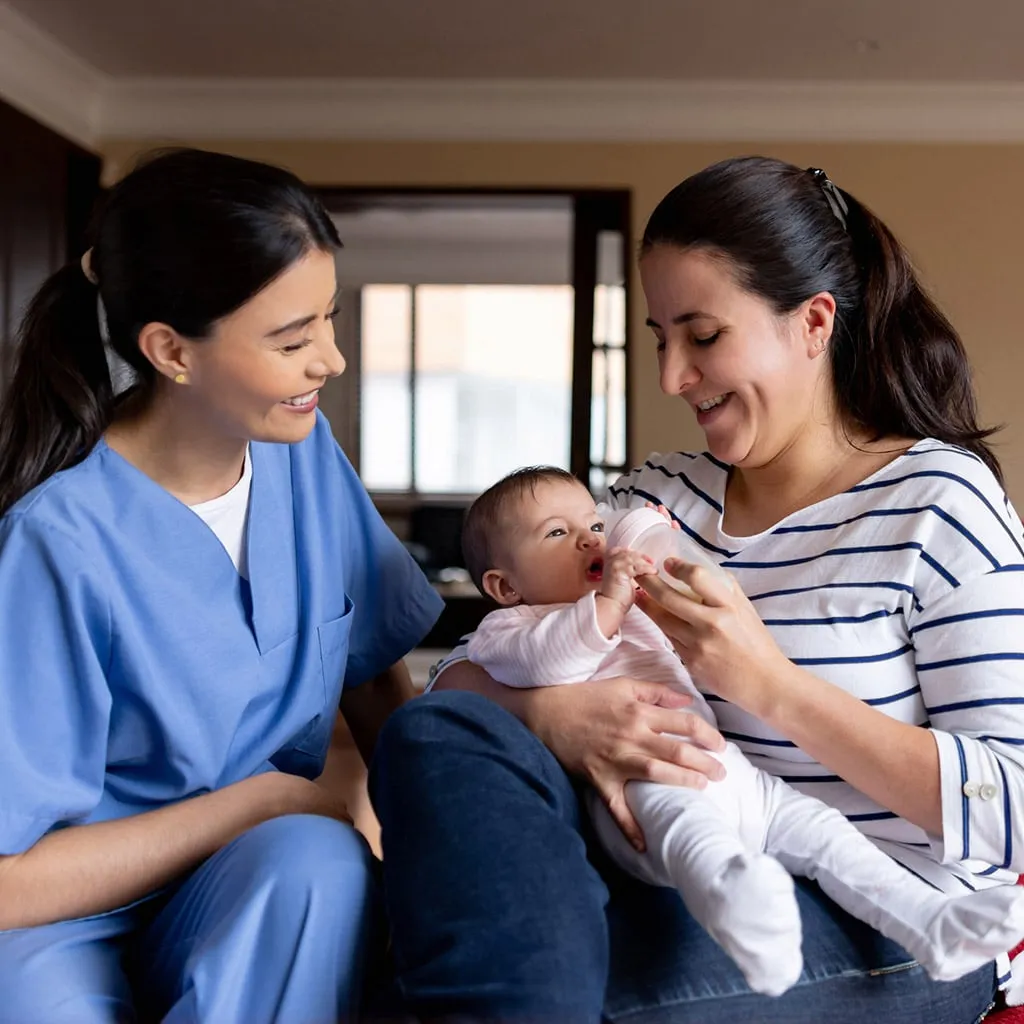
Pediatric home care nursing is medical care delivered by a licensed nurse, an RN or LPN, inside a child’s home rather than in a hospital, clinic, or nursing facility. It’s built for children with complex needs: seizure disorders, feeding tubes, ventilator dependence, or genetic conditions that require someone trained to monitor and respond to medical changes, not just supervise play or homework.
A pediatric home health nurse sits in a different category: licensed, trained specifically in pediatric care, and authorized to perform the clinical tasks a child’s condition requires.
A day of child home health care, in practice
No two care plans look identical, since every child’s needs are different. But most home health care for children falls into a few categories.
01
Clinical monitoring and intervention
Tracking vitals, blood sugar, or seizure activity; managing ventilators or tracheostomy care; administering medications on schedule; responding to changes as they happen.
02
Hands-on personal care
Bathing, feeding, mobility support, and toileting help for children who can’t manage these independently due to their condition.
03
Family support and training
A good pediatric home health nurse teaches parents and caregivers how to handle routine situations between visits, so families aren’t left guessing.
04
Coordination with the care team
Keeping your child’s pediatrician, specialists, and school aligned on the current care plan, instead of leaving parents to relay updates.

Is in-home pediatric nursing care right for your child?
Families usually start looking into pediatric home care services after a hospital discharge, a new diagnosis, or simple exhaustion from managing everything alone. It tends to make sense for a few broader situations.
- Neurological and genetic conditions that require ongoing monitoring or specialized handling.
- Technology-dependent children relying on equipment like ventilators, feeding tubes, or tracheostomies.
- Physical and mobility conditions that require hands-on daily support.
- Post-hospitalization recovery, where a child is medically stable enough for home but still needs skilled oversight.
This isn’t a complete list. Dozens of specific diagnoses can qualify, and eligibility comes down to medical necessity rather than a fixed set of conditions.
Why choose home nursing over hospital or clinic based care?
For a medically stable child, staying in a hospital longer than necessary carries real downsides: disrupted routines, higher infection risk, and separation from family.
| In-home nursing | Hospital / facility care | Outpatient clinic visits | |
|---|---|---|---|
|
Setting |
Child’s own home |
Clinical facility |
Requires travel each visit |
|
Continuity
|
Consistent nurse, familiar routine |
Rotating staff |
Limited to appointment time |
|
Family involvement
|
Parents trained and present daily |
Restricted visiting hours |
Minimal hands-on training |
|
Best fit for
|
Medically stable children needing ongoing skilled care |
Acute medical crises |
Periodic checkups, not daily care |
Home-based care isn’t a fit for every situation; a child in acute medical crisis still needs a hospital. But for children who are medically stable, home health care for children keeps them in a familiar environment without sacrificing the level of medical attention they need.
How Georgia families pay for pediatric home health nursing
Cost is usually the first question families ask, and it’s a fair one. In Georgia, most families accessing pediatric home care services do so through the Georgia Pediatric Program (GAPP), a Medicaid benefit that covers skilled nursing and personal care for medically fragile children at no out-of-pocket cost when approved. Families with private insurance can often still apply, with Medicaid coordinating as secondary coverage.

What to look for in a pediatric home health nurse
Not every home health nurse has pediatric-specific training, and the right fit matters as much as the credentials.
- Pediatric-specific licensure and experience, not just general home health credentials
- Experience with your child's specific condition, like ventilator care, feeding tubes, or seizure management
- Whether you have a say in scheduling and provider choice, rather than being assigned a rotating roster
- Communication style, since you'll be coordinating with this person regularly
At SLB In-Home Care, families participate directly in matching a nurse to their child rather than being handed a default assignment.
Starting pediatric home care nursing for your child
If you think your child could benefit from in-home pediatric nursing care, the process starts with a conversation, not paperwork. Our team walks through your child's condition and daily needs, then helps determine the right path forward.
Address
4751 Best Road, Suite #309
College Park, GA 30337
Phone
Address
Hours
Mon-Fri 7am-7pm
Sat-Sun 11am-5pm
Pediatric home health nursing near you in College Park, Georgia
SLB In-Home Care is headquartered in College Park and coordinates pediatric home health nursing near you across the greater Atlanta metro, including Fulton, Clayton, DeKalb, and Fayette counties. Care happens in your home, wherever that is in our service area, not at a clinic location.
Common questions
about pediatric home care nursing
What's the difference between a pediatric home health nurse and a regular home health aide?
A pediatric home health nurse is a licensed RN or LPN authorized to perform skilled medical tasks like medication administration, ventilator management, or wound care. A home health aide typically supports daily living tasks but isn’t licensed for clinical procedures.
What conditions typically require in-home pediatric nursing care?
Common examples include cerebral palsy, spina bifida, genetic disorders, traumatic brain injury, and technology dependence such as ventilators, feeding tubes, or tracheostomies. Eligibility is based on medical necessity, so many other diagnoses can qualify too.
Is pediatric home care nursing covered by insurance in Georgia?
Many Georgia families access it through GAPP, a Medicaid program that covers approved services at no out-of-pocket cost. Private insurance can often coordinate alongside it as secondary coverage.
How is in-home pediatric nursing care different from what a hospital provides?
Home nursing is designed for medically stable children who need ongoing skilled support without requiring a clinical facility. A hospital remains necessary for acute medical crises.
What should I look for when choosing a pediatric home health nurse?
Pediatric-specific licensure, direct experience with your child’s condition, and whether the provider lets you participate in choosing and scheduling your nurse rather than assigning one by default.
How do I get started with pediatric home health nursing near me in College Park?
Call 404-905-8332 or submit the contact form. We’ll walk through your child’s needs and the best path forward, whether that’s a GAPP application or another option.