Learn what failure to thrive means for children and how failure to thrive pediatric home care helps Georgia families through feeding support, nursing, and GAPP.
What does it actually mean when a pediatrician says the words “failure to thrive”? And why do so many Georgia parents leave that appointment feeling scared instead of informed? Those two questions matter because the diagnosis itself is not a judgment of your parenting.It usually means your child is not gaining weight, growing, or meeting nutritional needs the way doctors expect. For some families, the day to day work of feeding schedules, medications, and weight checks becomes more than one household can manage alone.That is where failure to thrive pediatric
home care starts to make a real difference.
Quick Takeaways- Failure to thrive means a child isn’t getting, absorbing, or using enough nutrition, not that a parent did something wrong
- Home care isn’t automatic for every child with poor weight gain, it depends on physician orders and documented medical necessity
- Skilled nursing support can include feeding monitoring, tube feeding help, intake logs, and medication reminders when approved
- Georgia families may qualify for no cost nursing through the Georgia Pediatric Program (GAPP) if their child meets state criteria
- Preparing medical records and feeding details ahead of time speeds up the assessment process significantly
What Failure to Thrive Means for Children
Failure to thrive is not one disease. It’s a description doctors use when a child isn’t receiving, absorbing, or using enough nutrition to grow the way expected for their age. The scale used to track this looks at weight, height, and head circumference over time, comparing your child’s own growth curve against expected patterns rather than judging a single visit in isolation.
The causes behind poor weight gain vary widely, and a home care agency will never diagnose them. That job belongs to your child’s medical team. Contributing factors doctors investigate may include:- Feeding difficulty or oral motor coordination problems
- Reflux or repeated vomiting after meals
- Swallowing problems that raise aspiration risk
- Chronic illness or premature birth history
- Digestive issues affecting nutrient absorption
- Heart or lung conditions that increase calorie burn
- Metabolic conditions that change how the body uses nutrition
Who Actually Makes the Diagnosis
A pediatrician usually leads the evaluation, often bringing in a dietitian to calculate calorie goals and a gastroenterologist if digestive symptoms are involved. Speech therapists and occupational therapists frequently join the team too, since feeding related growth delay often involves swallowing mechanics or sensory issues around eating.No home care agency replaces this team. What good home care does is support the plan that team builds, and families can read more about
daily care routines for a medically fragile child to see how that support fits into everyday life.
When Pediatric Home Care May Actually Help
Here’s the part most explainer articles skip. Not every child with poor weight gain needs a nurse in the home. A baby who’s slightly below the growth curve but eating well with outpatient dietitian support probably doesn’t need skilled nursing. That’s a normal, manageable situation handled through regular pediatrician visits.Home care starts to make sense for a different profile of child. Think complex feeding needs, tube feeding, frequent weight checks, multiple medications on a schedule, or a broader medically fragile status where any one symptom could escalate quickly.The deciding factor is never the parent’s stress level alone, though that matters. It’s whether a physician has written orders indicating the child needs skilled monitoring or interventions that go beyond what a caregiver can safely do without training.If your child’s pediatrician mentions “failure to thrive” but hasn’t discussed
home nursing, ask directly whether your child’s feeding complexity or medication schedule would qualify for a home care evaluation. Many parents assume they have to bring it up themselves, and they’re right.A licensed agency builds its plan of care directly from those physician orders. Home care is one option among several, sitting alongside outpatient feeding therapy, gastroenterology follow up, and specialist visits. For some families it’s the missing piece, and comparing
pediatric daycare vs in home nursing can help clarify which setting fits your child best. For others, it’s not the right fit yet, and that’s a normal outcome too.
How Failure to Thrive Pediatric Home Care Supports Families
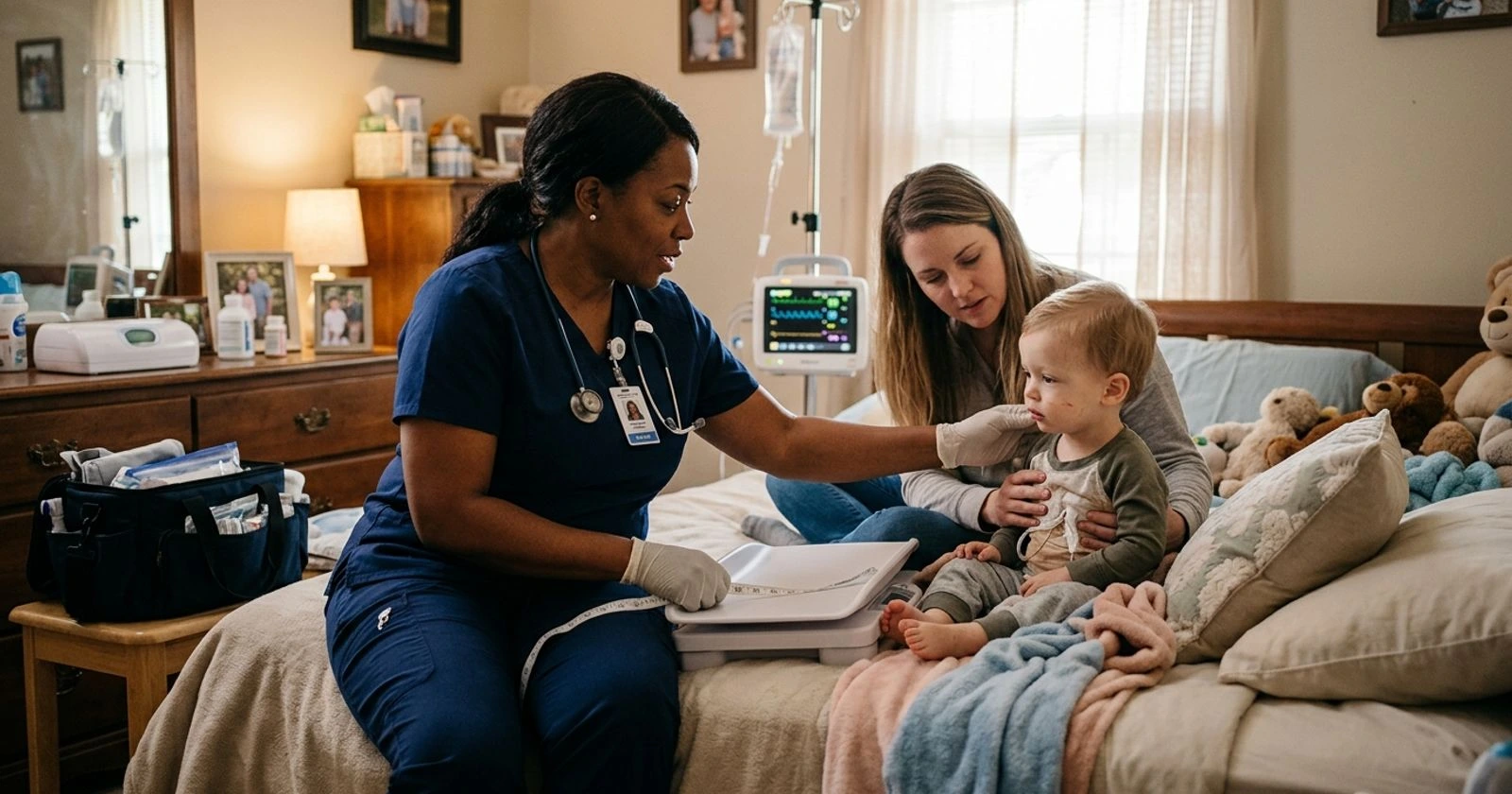
When a child is approved for skilled nursing, the actual day to day support depends entirely on the care plan and physician orders written for that child. Based on what’s ordered, a home care nurse’s tasks may include:- Monitoring feeding routines and how well the child tolerates each feed
- Helping the family follow a physician ordered feeding schedule consistently
- Supporting formula preparation or tube feeding when ordered, including G tube or NG tube care
- Tracking intake, output, vomiting, reflux symptoms, wet diapers, and bowel movements in a daily intake log
- Watching for dehydration signs or feeding intolerance that need reporting
- Helping with medication reminders and keeping the medication schedule on track
- Supporting safe positioning during and after feeds to reduce aspiration risk
- Communicating any changes back to parents and the wider care team
- Providing overnight or extended hour support when the care plan approves it, which also ties into preventing hospital readmissions for kids with complex feeding needs
Why the Intake Log Matters More Than Parents Expect
A daily intake log sounds like paperwork, but it’s often the single most useful tool a family has at the next pediatrician or gastroenterologist visit. Instead of trying to recall three weeks of feeding patterns from memory, the family shows up with actual data on ounces taken, reflux episodes, and diaper output. That data shapes real medical decisions faster.None of this replaces the family’s relationship with their child’s doctor. What it does is close the gap between appointments, when a lot of the actual feeding and monitoring work happens.
Building Feeding and Nutrition Routines That Actually Stick
Consistency is the hardest part of managing failure to thrive at home, and it’s rarely discussed honestly. A child on structured feeding times, specific calorie goals, thickened feeds, or a tube feeding schedule needs that routine followed almost exactly, day after day. One parent doing this alone, especially while managing other kids, a job, and their own sleep, often can’t hold that line indefinitely.Feeding therapy exercises recommended by a speech therapist or occupational therapist also need repetition to work. Special formulas prescribed by a dietitian need accurate measuring every single time. G tube and NG tube schedules need to run on time, tracked carefully, with the family or nurse watching for problems.Home care staff help families hold that consistency day to day. What they do not do is change calorie goals, formula type, or feeding volume on their own. Those decisions always come from the child’s healthcare team, and any nurse in your home should be communicating changes back to that team, not making calls independently.
GAPP and What It Means for Medically Fragile Georgia Kids
Georgia families have an option many parents don’t discover until months into their child’s diagnosis. The
Georgia Pediatric Program, known as GAPP, may cover skilled nursing care at home for eligible children ages 0-21 who meet Medicaid criteria and medical necessity requirements.Approval requires state review, and every child’s situation gets assessed individually against the state’s guidelines. Families new to the process can start with
GAPP info for families before requesting an assessment.This is where SLB In-Home Care fits into the picture.The agency provides skilled and unskilled nursing, at no out of pocket cost once approved by Georgia Medicaid, for medically fragile children through the GAPP Medicaid program, and part of what makes the process less overwhelming is having someone walk you through
how to apply for GAPP in Georgia instead of figuring it out solo.That includes helping families gather documentation, requesting the home assessment, and organizing next steps once a physician has recommended home nursing. Families already enrolled should also know
how GAPP hours are reauthorized in Georgia before coverage lapses.Approval isn’t guaranteed for every child, and no agency can promise a specific outcome. What families get from working with an experienced GAPP focused agency is a clearer, faster path through a process that otherwise involves a lot of paperwork and waiting, and it’s worth reviewing
how the GAPP application actually works before starting.
Some situations point clearly toward needing more help than a single caregiver can provide. None of these mean you’re failing. They mean the workload has outgrown what’s realistic for one household to manage without support.
- Feeding takes up most of the day, leaving little time for anything else
- Your child struggles with vomiting, reflux, choking concerns, or poor feeding tolerance
- Weight checks and intake tracking feel like a constant source of stress
- Parents are running on empty from overnight feeds night after night
- Your child has a feeding tube or a complex medical routine to manage
- Instructions from multiple specialists feel impossible to coordinate alone
- Work, siblings, appointments, and caregiving are competing for the same hours
- Your child has had repeated hospital visits or frequent medical follow ups If two or three of these sound familiar, it’s worth having a conversation with your child’s pediatrician about whether a home care evaluation makes sense. Exhausted parents should also look into respite care options built specifically for GAPP families juggling this kind of workload.
Managing Failure to Thrive Alone vs. With Pediatric Home Care Support
| Area | Managing Alone | With Approved Home Care Support |
|---|
| Feeding schedule consistency | Easy to miss timing during work, school runs, or sleep | Trained staff help hold exact feeding windows daily |
| Intake and output tracking | Often tracked inconsistently or from memory | Logged in real time in a daily intake log |
| Tube feeding support | One parent handles all G tube or NG tube feeds alone | Shared responsibility reduces missed or rushed feeds |
| Parent rest and burnout | Overnight feeds fall entirely on one or two people | Overnight support available when approved in the care plan |
| Communication with care team | Parent relays symptoms from memory at appointments | Nurse documentation gives the care team clearer data |
| Safety monitoring | Aspiration risk and dehydration signs may go unnoticed | Trained eyes watch for warning signs during every feed |
| Daily routine stability | Routine breaks down during illness, travel, or stress | Structure holds steady even during high stress periods |
What to Gather Before You Request Home Care Support
Assessments move faster when families arrive prepared. Before requesting a pediatric home care evaluation, put together:
- Your child’s diagnosis and any related medical concerns
- Current weight and growth chart details from recent visits
- The current feeding schedule, including times and volumes
- The formula or nutrition plan currently in use
- Tube feeding orders, if your child has a G tube or NG tube
- A full medication list with dosing times
- Notes from any specialists involved, including gastroenterologist or speech therapist visits
- Records of recent hospitalizations
- Therapy recommendations from occupational or speech therapy
- Medicaid or insurance details
- Your own honest concerns about feeding, safety, sleep, or burnout
Having this ready doesn’t guarantee approval, but it removes a lot of the back and forth that slows the process down. It also helps to review guidance on preparing for
long term home nursing care so you know what documentation reviewers typically ask for. Families whose child has broader medical complexity beyond feeding may also want to check the
Medically Fragile Child Waiver Georgia program alongside GAPP.
Why Families Choose SLB In-Home Care
the platform works with Georgia families raising medically fragile children, including kids dealing with feeding challenges, poor weight gain, and complex daily care needs. The agency’s approach centers on pediatric skilled nursing, GAPP application assistance, and communication that puts parents in the loop rather than leaving them guessing.Services also cover unskilled personal care, post surgery care, and consulting support for families still figuring out what their child needs, and working parents balancing jobs and caregiving can learn more through
GAPP support built for working parents.No agency can promise your child will be approved for GAPP funding. What the platform can offer is experienced guidance through the assessment and application steps, along with skilled nurses trained in feeding support, tube feeding, and the daily tracking that failure to thrive care requires.If your family is trying to figure out whether failure to thrive pediatric home care fits your child’s situation, the next step is simple.You can also read more about how to
get free pediatric nursing care in Georgia or explore
free in home care for a disabled child in Georgia to understand the full scope of GAPP funded support.Request a pediatric home care assessment, check whether your child may qualify for GAPP support, or
reach out through the GAPP contact page to talk with the platform about your child’s feeding related needs before making any decisions.
See if your child qualifies and get a clearer picture of what support is actually available in Georgia right now.
Frequently Asked Questions
What does failure to thrive mean in children?
It means a child isn’t gaining weight, growing, or getting enough nutrition compared to expected patterns for their age. It’s a description of a growth pattern, not a diagnosis of a specific cause, and requires evaluation by a pediatrician or specialist.
Can failure to thrive qualify for pediatric home care?
It can, depending on the complexity of the child’s feeding needs and whether a physician orders skilled nursing support. Not every child with poor weight gain qualifies, since eligibility depends on medical necessity and documented orders.
What can a home nurse do for a child with feeding difficulties?
Based on the child’s care plan, a nurse may monitor feeding tolerance, follow a physician ordered feeding schedule, track intake and output, and watch for dehydration signs or reflux symptoms. Exact tasks always depend on physician orders.
Can pediatric home care help with tube feeding?
Yes, when ordered by a physician, trained staff can support G tube or NG tube feeding, formula preparation, and safe positioning during feeds. This support is written into the child’s individual care plan.
Is failure to thrive always caused by poor feeding?
No. Causes can include reflux, swallowing problems, chronic illness, digestive issues, heart or lung conditions, or metabolic conditions, among others. A pediatrician, dietitian, or gastroenterologist evaluates the underlying cause.
Can GAPP help cover home nursing for children with failure to thrive?
GAPP may cover skilled nursing for eligible Georgia children ages 0-21 who meet Medicaid and medical necessity requirements. Approval depends on state review of the child’s specific medical situation.
Useful details include the child’s diagnosis, feeding schedule, formula plan, medication list, specialist notes, recent hospitalizations, and Medicaid information. Having this ready helps the assessment move more smoothly.
Can home care help with overnight feeding routines?
Yes, overnight or extended hour support may be available when it’s part of the approved care plan. This can ease exhaustion for parents managing frequent nighttime feeds.
Yes, SLB
In Home Care provides skilled nursing support for children with G tubes, NG tubes, and other complex feeding needs when ordered by a physician. Support is built around each child’s individual care plan.
How do I start pediatric home care in Georgia?
Start by talking with your child’s pediatrician about a home care evaluation, then check the
am I qualified for GAPP page to review eligibility. Gathering medical records and feeding details ahead of time helps speed up the process.
Related Guides